

Last updated June 2026
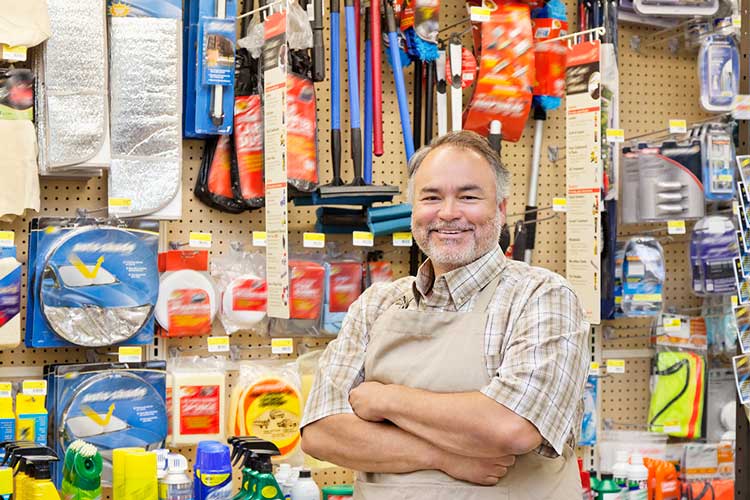
A good hardware store operates like a combination of a supply storehouse and DIY therapy center. The best ones not only stock a wide array of tools and supplies; they also employ professional know-it-alls who can tell you what you’ll need for your weekend remodeling project or describe the best way to unclog that pesky drain.
Unfortunately, although big chains Home Depot, Lowe’s, and Menards offer low prices, Consumers’ Checkbook’s ratings of retailers find they often offer subpar advice and customer service. Luckily, we found that many independent stores offer helpful staff and fair prices.
Comparing Prices
To see how stores stack up for costs, our undercover shoppers checked prices for 20 items at hundreds of stores located in seven major metropolitan areas.
For prices, Amazon, Home Depot, Lowe’s, and Menards beat most other chains and independents. Menards’ prices were about 27 percent less than the all-store average, Home Depot’s about 22 percent lower than average, Amazon’s about 20 percent lower, and Lowe’s 15 percent lower than average. But in each of the seven metro areas, our price survey found below-average prices at several independent stores.
At some stores, you can save money just by asking for a discount. Some independent stores offer 10 to 15 percent off for customers who use a store charge account or the store’s own credit card. Because our price comparison scores don’t take such discounts into consideration, these discounts would make those stores’ prices more competitive with the big chains.
For large projects requiring a lot of equipment and materials, you might get a five to 15 percent contractor’s discount from an independent store—but not from the big chains—just by asking. Some stores offer discounts to homeowners who plan to spend over $1,000—and in some cases even less—over a couple of weeks. Our price comparison scores don’t reflect such discounts.
Getting Good Advice
For many customers, price is just part of the deal: They also want good advice, assistance finding what they need, and customer service. Running a top-notch hardware store starts with recruiting well-informed, helpful staff. Because the best hardware store salespeople must possess the knowledge of plumbers, painters, electricians, roofers, landscapers, carpenters, and a dozen other tradespeople, finding and retaining a cadre of smart staff isn’t easy. In addition, top hardware stores somehow manage to stock just about everything their customers need, and to organize this amazing jumble of products so shoppers and staff can find them.
To evaluate stores for service quality, we asked consumers in seven metro areas to rate stores they’ve used as “inferior,” “adequate,” or “superior” on several questions, including “advice on choice and use of products,” “promptness of service,” “staff attitudes/atmosphere,” “ease of looking at/testing products,” “variety of products,” “reliability (standing behind products, doing what’s promised, etc.),” and “overall quality.”
Unfortunately, price leaders Home Depot, Lowe’s, and Menards fall well short on some key service fronts. In our surveys of consumers, Home Depot received “superior” ratings for quality of advice from only 37 percent of its surveyed customers, Lowe’s from only 40 percent, and Menards from only 46 percent. In contrast, in each of the seven metro areas, several independent stores received “superior” ratings for advice from at least 90 percent of their surveyed customers.
Among the many Ace and True Value stores, there’s no consistent pattern in ratings for advice or other aspects of service. That is not surprising, since Ace and True Value are buying cooperatives for independent stores that impose no performance standards or specific operating procedures on affiliates.
Whichever store you choose, seek out the specific clerks who dole out the most helpful advice. Over time, you’ll learn who they are by trial and error, but you can expedite the process by asking questions—for example, “Who knows the most about plumbing?”
In contrast to their low ratings for quality of advice, the big national chains scored better when we asked their customers about variety of products. Although indie stores generally don’t rate as high for variety as for advice, many do a masterful job—often in a relatively small space—of offering the variety of items their customers want.
In addition to having a wide range of products, hardware stores also vary in special services offered. Services such as tool sharpening, key making, and glass cutting are offered by many stores, while bicycle and lawn mower repair are offered by very few. Some stores offer free classes on topics like landscaping, floor installation, and cabinet installation. And of the many places you can rent tools, your local hardware store is probably the most convenient.
Know the Return Policy
Because it’s easy to miscalculate the volume of paint, number of nails, or types of hinges a job needs, it’s important to buy from hardware stores with liberal return policies. And if you purchase materials for a project ahead of time, it may be months before you realize that you have too much, the wrong thing, or a defective product. It helps to buy from a store that willingly accepts returns.
From the store’s standpoint, however, there are real disadvantages to a liberal return policy. First, long delays may mean a store no longer carries the product customers want to return. Second, customers probably will have damaged the packaging. Hardware manufacturers, for inventory and merchandising purposes, now prepackage many items formerly sold out of bins or from other types of open displays.
Everything from bolts to braces now comes sealed in clear plastic packs. If you find out only after opening the package that you need to return an unsuitable corner brace, the store knows it will be very hard to sell. A further problem is crime: Like other types of retailers, hardware stores must deal with shoplifters who seek cash refunds for stolen merchandise.
Despite these problems, return practices at most hardware stores are remarkably liberal. Almost all offer full refunds on returns for indefinite periods—as long as customers present receipts and items can be resold. And managers whose stores’ stated policies impose time limits and proof of purchase requirements indicate that, in practice, they are often much more flexible. Even if a sign over the checkout counter says “No returns after 30 days,” the store might offer regular customers a refund on merchandise purchased over a year before. Some stores even offer refunds to regular customers who have no receipts and even if the items have no price tags.
