

CPSC Bans Dangerous Water Beads Sold as Toys
Last updated March 12, 2026
Listen to audio highlights of the story below:
Water beads, tiny, colorful pellets that expand when soaked in water, are now subject to federal safety regulations designed to protect children from the hazards of ingesting them.
A new rule from the U.S. Consumer Product Safety Commission that took effect March 12 bans water beads in toys if they expand in water to more than five millimeters in diameter. It also limits the amount of acrylamide, a potential carcinogen and neurotoxin often found in the beads.
“Water beads that fail to meet the new federal standards are now illegal to sell in the United States,” said CPSC Acting Chairman Peter Feldman. “Manufacturers of these products, most of whom are based in China, must meet the new federal standard or face the full weight of CPSC enforcement.”
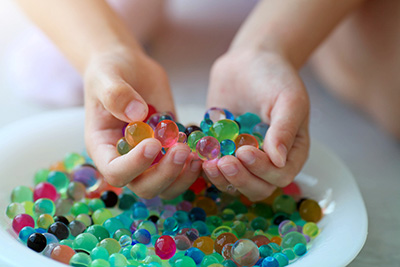
Why Water Beads Pose Serious Dangers to Children
Consumer advocates, some of whom had hoped the CPSC would ban all water bead toys, are happy with the new rule.
“This overdue commonsense step should reduce the risk of playtime turning into tragedy,” said Teresa Murray, director of the Consumer Watchdog office at the nonprofit advocacy group U.S. PIRG.
These colorful gel balls were developed decades ago to help plants retain moisture. In 2010, they hit the market as toys and Murray can’t figure out why that ever happened: “What in the heck were they thinking? Let’s make a toy that looks like candy, but if someone eats it, it could literally kill them,” she said.
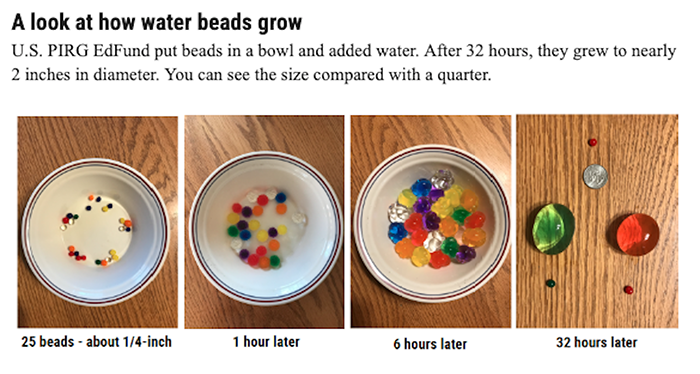
Water beads don’t look dangerous. Before they expand, they’re about the size of ice cream sprinkles. Made of superabsorbent polymers, water beads can absorb hundreds of times their weight in water without dissolving, according to the National Capitol Poison Control.
This time-lapse video from Consumer Reports shows how water beads the size of Cheerios grow to nearly the size of golf balls when placed in water.
“And these are designed to be enticing to children,” said Gabe Knight, senior policy advocate at Consumer Reports. “They’re colorful; they look like candy when they’re dehydrated.”
Because they are so small, they are easy to lose. Toddlers and young children might find stray beads that fall onto the floor and swallow them or put them in their noses or ears. As the beads expand, they can cause “dangerous and sometimes permanent injuries,” Knight said, including hearing loss, infections, bowel obstructions—and in some cases—death.
CPSC data show that an estimated 6,300 children were treated in hospital emergency rooms for water bead-related ingestion injuries from 2017 to 2022. It’s often difficult for doctors to diagnose the problem because water beads don’t always show up on X-rays. In many cases, surgery is required to remove intestinal blockages.
What the New Water Bead Ban Does Not Do
The CPSC’s new rule will not ban all water beads sold as toys. And they can still be sold for other purposes, such as decorative vase fillers and plant hydration.
The rule establishes three major safety standards for water beads marketed as toys:
- Sets the maximum expansion size at five millimeters—small enough to prevent the beads from causing blockages if ingested, or other injuries if inhaled or inserted into an ear or nose.
- Requires “strongly worded, visible” warning labels that clearly convey the potential dangers.
- Limits the amount of acrylamide, a potentially toxic chemical found in the polymers used to make water beads.
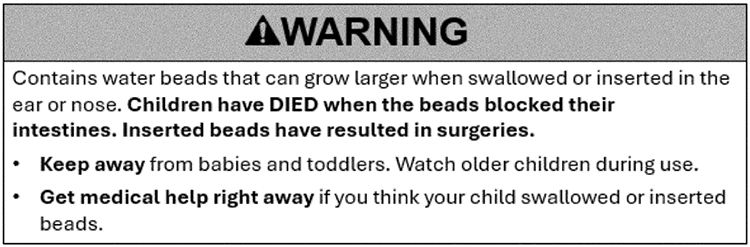
This is not a recall: The new rule does not apply to water beads already in homes and daycare centers. So, parents and guardians need to remain vigilant.
“If you see these at a daycare, if you see them at another child’s home, make it clear these are not safe, and don’t let a young child play with them,” CR’s Knight said.
A Long Time Coming
In 2013, “Cosmo Beads” were the first water bead toy recalled in the U.S. Many other recalls followed. In 2023, consumer advocates and parents called for government action following the death of a toddler in North Prairie, Wisconsin. In July of that year, Taylor Bethard found her 10-month-old, Esther, dead in her crib.
“It’s a miserable, miserable feeling to lose your child,” Bethard told WPVI-TV in Philadelphia. “No parent should ever have to go through that.”
In December 2023, Consumer Reports published a major investigation into the dangers of water beads and launched a petition drive to urge the CPSC to ban the beads or sharply limit their sale. Major retailers, including Amazon, Target, Walmart, and Michaels, promised to stop selling water bead toys. A year later, in 2024, the CPSC introduced its rule.
 Ashley Haugen, a mother in San Antonio, lobbied for the new rule after her toddler, Kipley, nearly died after eating water beads. She calls the rule “a historic victory for children and product safety.”
Checkbook first reported on Haugen in 2023. Her nonprofit That Water Bead Lady educates parents about the dangers of water beads. On her website, she shares Kipley’s story. Back in 2017, Ashley and her husband had no idea what was making Kipley sick.
“It was terrifying,” she recalled.
The doctors said Kipley needed immediate abdominal surgery. Surgeons removed the blockage, and Kipley went home.
 Before long, Kipley broke out with severe rashes, her personality changed, she stopped responding to her name, and her sleep patterns changed, Haugen told Checkbook.
Their pediatrician diagnosed Kipley with toxic brain encephalopathy caused by harmful chemicals in those water beads. Since the toy was labeled “non-toxic,” the Haugens believed it to be safe. But the term non-toxic is unregulated, so the claim was meaningless.
Haugen said she will “monitor the implementation of this life-saving action” by the CPSC, and vows to remain “a tireless advocate to ensure water bead toys never show back up in the United States.”
Advice to Parents and Guardians
If you already have water bead toys, even if they’re used by an older child, throw them away and thoroughly vacuum the house. If those beads get carried on shoes or clothing into another room, they can injure a younger sibling. No amount of adult supervision can keep children safe from water beads, Haughen cautions.
“They get everywhere into every nook and cranny, and you can do a wonderful job at cleaning up, and they get missed, and you don’t even realize it,” Haughen told us. “Imagine little pieces of glitter with the bouncing power of a Super Ball, and that’s a water bead.”
Some consumer advocates, including Consumer Reports and U.S. PIRG, had hoped Congress or the CPSC would ban all water beads. Because this did not happen, PIRG’s Murray cautions parents with young children and people with pets not to have water beads in the house for any purpose.
“You’re just asking for trouble, and this is just not something that you want to mess around with,” Murray said.
More Info from the CPSC:

Contributing editor Herb Weisbaum (“The ConsumerMan”) is an Emmy award-winning broadcaster and one of America's top consumer experts. He has been protecting consumers for more than 40 years, having covered the consumer beat for CBS News, The Today Show, and NBCNews.com. You can also find him on Facebook, Blue Sky, X, Instagram, and at ConsumerMan.com.