

Cryptocurrency ATMs Are Mostly Used as Payment Portals for Scammers
Last updated November 5, 2026
Scammers prefer cryptocurrency because it lets them receive funds almost anonymously, and transactions are instant and irreversible. One way they convince victims to send them money is by using crypto ATMs.
These criminals usually rely on fear to get victims to act—an arrest is imminent, the IRS says you owe back taxes, your bank account has been compromised. The scammer then steers the victim to a nearby crypto ATM to feed in cash, which is converted to digital currency and sent straight to the scammer’s wallet.
Losses at these machines are “skyrocketing,” according to the Federal Trade Commission, which calls them “a payment portal for scammers.” Last year the FBI received more than 13,400 complaints involving crypto ATMs, up 23 percent from 2024. Reported losses totaled $389 million, up 58 percent.
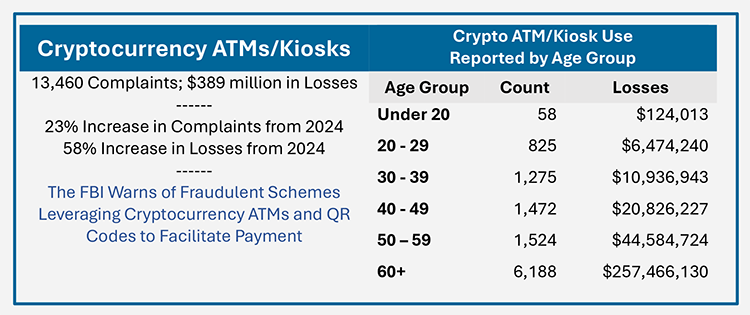
Since most victims don’t file complaints, actual losses are estimated at $2.7 billion, according to an analysis by the Consumer Federation of America.
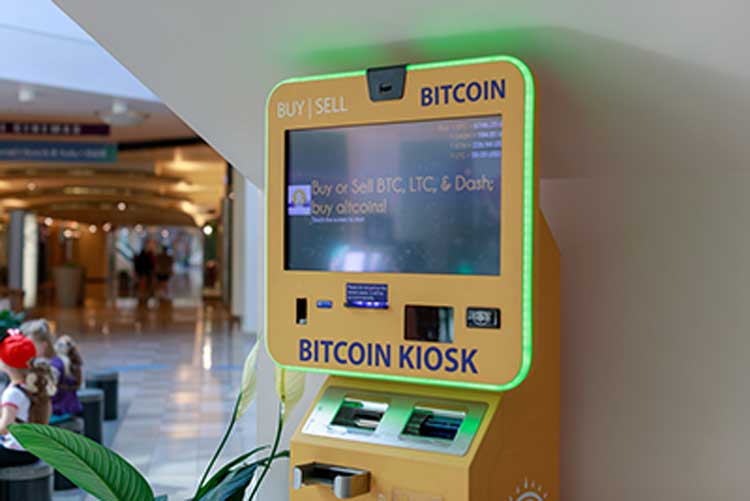
Nationwide, there are more than 20,000 crypto ATMs (also known as virtual currency kiosks or BTMs), often located in supermarkets, service stations, convenience stores, bars, and restaurants. So criminals can easily steer victims to one nearby.
Why Crypto?
“Crypto ATMs are like the perfect modern getaway car for criminals,” said Clark Flynt-Barr, government affairs director at AARP. “The money moves really fast, there’s very little regulation, and it’s very hard to recover the money.”
Some criminals still prefer to have their victims buy gift cards and then steal the money loaded onto them. But most stores limit gift card purchases. Transactions at crypto ATMs are unlimited in most states.
She Sent Criminals $17,000 in Bitcoin
Ellen, a retired educator in her early 70s, “was caught off guard” when she answered the phone and the caller, who identified himself as a law enforcement officer, said she was in trouble for failing to report for jury duty.
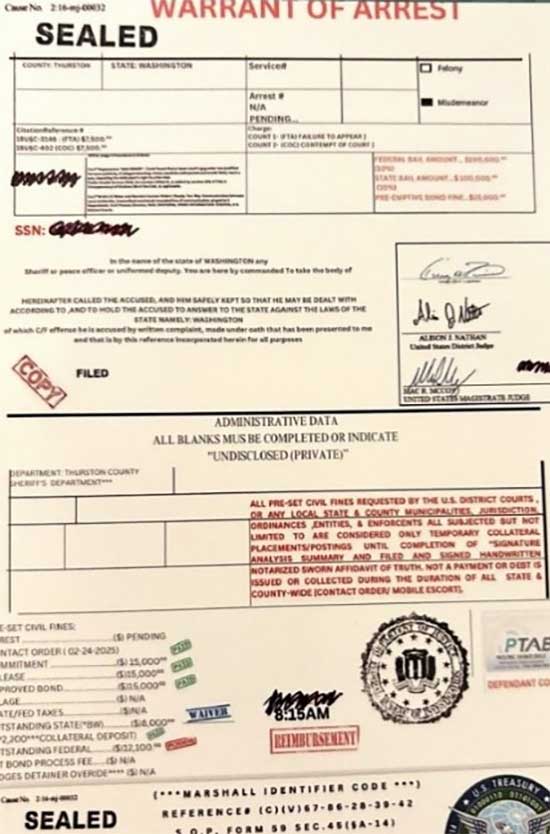 “He was very agitated,” Ellen recalled. He said he had a warrant for her arrest and that she needed to post bond and hire a lawyer. “Within minutes, I was just crying.”
Ellen (she asked us not to use her real name) had just moved to a new home in Olympia, Wash., so she assumed she had missed the jury summons letter.
The imposters texted Ellen counterfeit documents (containing her Social Security number) about her case and an upcoming judicial hearing.
“They looked so official and so real,” Ellen said. “These scammers did their homework; they have answers for everything.”
Ellen was instructed to withdraw $15,000 from her bank account. The criminals, listening in on her cellphone, told her to say she was buying a car or going on an expensive vacation if the teller questioned the withdrawal.
“I had been told that if I contacted the local police, I would be arrested. And I had no doubt that I would be arrested,” Ellen told Checkbook.
With cash in hand, Ellen was directed to a local crypto ATM. The crook on the phone reminded her to “get a receipt to give to the judge” and assured her she would be reimbursed.
“I go in, and I have my purse, and I’m putting in $100 bills in this machine over and over and over again,” Ellen said.
When she got back in her car, another fraudster was on the phone, telling her the money had been received, but now she had to deal with a second warrant from Washington state.
The next day, Ellen went back to the bank, withdrew $2,500, and sent it off via the crypto ATM.
On day three, as Ellen was preparing for her court appearance, the imposters called again, claiming the FBI had issued an arrest warrant and that she needed to return to the bank to withdraw more money.
Suspicious about the series of large withdrawals, the teller slipped Ellen a note asking her if she was OK. This time, Ellen said something, and the bank called the police.
During her three-day nightmare, Ellen said she didn’t eat or sleep. She was constantly on the phone with the scammers; they said she was “under house arrest” and had to check in every hour. She remembers speaking to at least eight different people.
Ellen realizes the money is gone. She agreed to share her story to warn others. Based on her experience, she no longer answers calls from unknown numbers and lets them go to voicemail.
“People will say, ‘Oh, you were so foolish. You were so stupid.’ I was uneducated,” she told Checkbook. “I tell people if you get a call like that, don’t panic, because that’s what they want to do. The second thing is to hang up; don’t call the number they gave you. Find the number for that company or organization yourself.”
Are There Legitimate Uses for Crypto ATMs?
Kiosk operators say that people without bank accounts and workers who receive cash tips, such as restaurant employees, use their machines to convert cash into crypto.
Consumer advocates say that’s not really happening.
“The reason you see the industry fighting against even the most basic protections is that if you regulate the fraud out of crypto ATMs, they cease being profitable,” said Corey Frayer, director of investment protection at the Consumer Federation of America.
Marc Grens, co-founder of DigitalMint, one of the earliest and largest crypto ATM operators in the U.S., echoed that assessment. DigitalMint had 1,400 locations in 35 states before shutting down in 2024. The company left the business after an internal analysis (tens of thousands of transactions over several years) found that nearly every transaction of $1,000 or more involved sending money to fraudsters.
Those findings highlighted what Grens called a “systemic problem” inherent to the cryptocurrency kiosk model: They couldn’t make money if they “did the right thing” and stopped suspicious transactions.
States Take Action
To combat rising losses from crypto ATM fraud, 30 states have enacted legislation, according to AARP. Some states now limit how much money a new customer can transfer per day. For example, the limits are $1,000 in California, $2,000 in Colorado and Florida, and $2,500 in Georgia.
In 2026, Indiana became the first state to ban the machines, followed by Tennessee and Minnesota. Some cities, including Spokane, Wash.; Layton, Utah; and Gloster, Mass., have also banned crypto kiosks.
In addition, several states and the District of Columbia are suing some of the country’s largest crypto ATM operators.
Earlier this year, Massachusetts Attorney General Andrea Joy Campbell sued Bitcoin Depot for allegedly “knowingly facilitating crypto scams that robbed Massachusetts consumers of millions of dollars, refusing to issue refunds to scam victims, and deceiving investors about the level of scam activity on Bitcoin Depot kiosks.” The lawsuit further alleges that Bitcoin Depot employees “had warned the company that nearly all its large transactions were related to scams, to no avail.”
In February 2025, Iowa Attorney General Brenna Bird sued Bitcoin Depot and CoinFlip for allegedly allowing hundreds of Iowans to transfer at least $20 million to scammers in less than three years. The AG’s investigation found that 98 percent of transactions with Bitcoin Depot and 95 percent with CoinFlip involved sending money to scammers.
CoinFlip called the Iowa AG’s lawsuit “meritless” and a “misguided attack” on a company that had long supported consumer protection laws for crypto kiosks.
Bitcoin Depot (with more than 9,200 kiosks in the U.S., Canada, and Australia) filed for bankruptcy and announced plans to shut down in May. The company said it had been strengthening its procedures to combat fraud and protect customers, but concluded that “the current regulatory environment had made the company’s business model unsustainable.”
In September 2025, the District of Columbia Attorney General sued Athena Bitcoin, the country’s largest crypto ATM operator, for allegedly “failing to implement adequate anti-fraud measures” and “charging undisclosed fees on deposits that it knows are often the result of scams.”
The D.C. AG alleges that 93 percent of Athena deposits “were the direct result of scams.” While the median loss per scam transaction was $8,000, the lawsuit noted that one victim lost $98,000 in 19 transactions over several days.
Athena denies any wrongdoing. The company says it uses aggressive, robust safety protocols and includes prominent on-screen fraud warnings intended to protect consumers.
Warnings Don’t Work
Many crypto ATM operators post scam alerts near their machines or display them on the screen. Fraud experts tell Checkbook these alerts are rarely effective because, in the moment, victims don’t realize they’re being manipulated and believe they must follow the instructions.
Ellen saw a warning sign by the kiosk where she made her first transfer ($15,000) to the crooks. When she asked the imposter on the phone about it, her told her to ignore it.
If you think you’ve fallen for a crypto scam, contact the FBI’s Internet Crime Complaint Center (IC3).
If you want to invest in crypto, and understand the risks involved with digital currency, your best bet is to use a well-known crypto exchange or broker. Crypto kiosk operators often charge exorbitant fees of 20 to 30 percent per transaction.

Contributing editor Herb Weisbaum (“The ConsumerMan”) is an Emmy award-winning broadcaster and one of America's top consumer experts. He has been protecting consumers for more than 40 years, having covered the consumer beat for CBS News, The Today Show, and NBCNews.com. You can also find him on Facebook, Blue Sky, X, Instagram, and at ConsumerMan.com.