

Last updated February 2026
The average American family does eight to 10 loads of laundry a week. But how do you know if you’re getting the most out of your washer and dryer while being gentle on your clothes and sheets? Herb Weisbaum, host of our Consumerpedia podcast, spoke with Rich Handel, a senior test engineer at Consumer Reports, who shared tips on removing stains, maximizing the performance of appliances, and whether dryer sheets actually work.
Here’s a trimmed-down transcript of the chat; to hear all the come-clean advice, head to Consumerpedia.org to listen to the full episode.
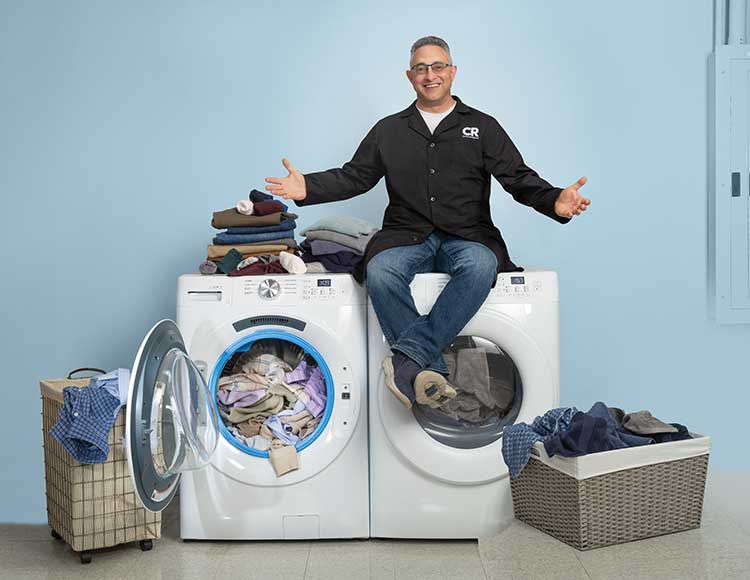
Herb Weisbaum: How does Consumer Reports test washers, dryers, laundry detergents, and stain removers?
Rich Handel: In our lab, we control the washing machine water, temperature, and volume. We weigh the detergent and have standardized loads and standardized stains. Plus, we use a device called an accelerometer to measure the vibration. We do an unbalanced load test. It’s all so consumers can make better choices.
H.W.: How do you sort dirty laundry? The default for most people is a dark load and a light load. Is that enough?
R.H.: Usually, that’s enough. But you also want to separate by weight. Don’t put lighter-weight items with heavier things. The heavier items will beat up on the lighter ones.
It also really depends on how much you care about your clothes. If it’s a cherished, threadbare concert T-shirt and you put it in there with towels and jeans, it’ll probably be even thinner when it comes out.
H.W.: What about pretreating stains?
R.H.: Consumer Reports found that a high-performing liquid detergent works as well as a pretreater [like 409 or OxiClean]. The key to most stains? Deal with them as quickly as possible. Try to blot away as much as you can. Then when you get home, pretreat it and deal with it. The best practice is to let the treatment sit for a few minutes.
You may even want to pretreat the stain, rinse it, pretreat it again, and re-rinse it in the sink before you put the garment in the washing machine. After the drying cycle, check if the stain is totally removed. If it’s not, repeat the procedure. Once you put it in that dryer, the heat sets the stain.
H.W.: To save money and energy, you want to run a full load in the washing machine or dryer. Is it a problem if you overload them?
R.H.: Yes, in the washer, the clothes and the detergent solution need to circulate. For the dryer, it’s similar. You need room for the clothes to fluff out and for the hot air to circulate.
For a top-load washer, fill it up loosely and leave space on the top. For the top loaders, there’s usually a plastic ring near the door. Don’t go above that. If you overfill the washer and try to cram everything in there, it’ll take longer and you’ll need to wash your clothes more because the washer is not going to be effective.
H.W.: How can I keep my laundry loads balanced?
R.H.: If you put light items with heavy items, say bed sheets with towels, the towels will absorb a lot more water and they’ll throw the machine off balance. It may not even get to the highest speed [since it must] spin out the water. A top loader could possibly “walk” and pull the hoses out of the wall if it’s unbalanced. So put all of your sheets together and all of your towels together.
H.W.: Does using extra detergent result in cleaner clothes?
R.H.: Not always. We suggest starting with the least amount of detergent and going from there to get your desired results. When you use too much detergent, you’re going to leave a residue on the clothes and create a buildup in the machine.
H.W.: In Consumer Reports’ testing, does one type of detergent perform better than others?
R.H.: We found that liquids and pods do a little bit better than the powders overall. Sheets and strips, which are relatively new, don’t perform as well.
H.W.: What about fabric softener?
R.H.: You could skip it. It’s essentially putting conditioner on your clothes to make them feel soft, and it leaves a residue and reduces the flammability rating for clothes (especially important for infants). Fabric softener also reduces the absorbency of towels.
There are other things you can do to help a little bit with softness. You can use wool balls in the dryer, which kind of break up [the load] as it’s drying and soften things a little. If what you want is fragrance, soak a paper towel with your favorite perfume and slip it in your drawer. It’ll permeate the clothing and give it fragrance.
H.W.: Will hot water clean better than cold water?
R.H.: Most manufacturers have moved to formulations that work well in cold water. We have tested them and they work well. If someone in your house is sick or has allergies, you might want to use warm or hot water. Many machines also have a “sanitize” cycle.
But check the care labels to see if it’s safe to use hot water on your items. Most manufacturers label garments and textiles with the safest settings to use to protect them so they don’t get damaged.
H.W.: If the fabric care label on a garment or textile says, “may be dry cleaned,” does that mean you can wash it?
R.H.: Yes. Usually, it can be washed in a delicate cold cycle and hung dry. Care labels are obviously there so you don’t damage your clothes to help them last longer.
H.W.: Are there things you should never throw in the washing machine?
R.H.: Some people wash things like sneakers and baseball hats. Even some manufacturers say you can do that. But the glues can break down, and materials can lose their form, so I would spot clean them instead.
H.W.: What about dryer sheets? Should I use them?
R.H.: You could skip those, too—they’re no different than a fabric softener. They’re wax-based and leave a film on clothes. If you’re using dryer sheets to reduce static, try the wool balls instead.
Dryer sheets can also leave a residue on the moisture sensor in your dryer. The sensor is usually two metal strips inside the dryer door. It gauges the moisture in clothes as they dry. Get residue on it, and the sensor won’t be as accurate. Clean it with a cotton ball soaked in isopropyl alcohol; that should keep the performance up.
H.W.: What do Consumer Reports’ tests say about whether to buy a front-loading or top-loading clothes washer?
R.H.: Front loads are the highest performing machines and are also the most water- and energy-efficient. They remove the most water because their spin cycles can be higher speed [due to] the orientation of the drum. Top-load, high-efficiency washers with impellers are still a little more efficient than those with agitators. They’re also gentler [on garments] than the agitators. Top-load agitators use a little bit more water and are more aggressive on clothes.
H.W.: Any tips to help washing machines last longer?
R.H.: Let’s say you do a couple loads a day. After the last load, wipe down the washing machine door and the gaskets. Open the detergent tray and wipe it down, too. If you don’t have young children around, leave the washing-machine door slightly ajar and open the soap dispenser to let them dry out between uses. If you don’t do that, you’ll end up with that funky smell and a moldy look on the gasket.
H.W.: I bet most people don’t know their washing machine has a filter until it clogs and emits a horrible smell. That filter needs to be cleaned before there’s a problem.
R.H.: Many front loaders have filters to protect the circulating motor, so the washer doesn’t take in any large objects—pocket change, a hair barrette. The filter catches these items before they hit the motor. If your machine isn’t draining, that’s probably the problem.
The filter is usually at the front of the machine, usually a little door. To clean it out, twist out the hose to drain, then twist out the filter. It’s relatively easy, but check your owner’s manual.
H.W.: What about clothes dryer maintenance? Do I need to do anything besides empty the lint filter and remove the built-up lint in the hose that runs outside the house?
R.H.: You might want to clean the duct and check for blockages a couple of times a year, and also look outside where the exhaust pipe goes. Make sure there’s nothing there blocking it.
Clean out the lint filter after every load. Periodically wipe down the moisture sensor and make sure there’s no residue, even if you don’t use dryer sheets. Some residue can build up on it and reduce its accuracy.
Related from Consumer Reports: