

Last updated June 2026
Consumers’ Checkbook chatted with digital media expert Mara Einstein about her book, which reveals how to avoid being fooled by brands and influencers.
Click below to listen to our Consumerpedia podcast episode.
 Businesses will seemingly use any marketing tool to try to get and retain customers. Clothing designers tempt buyers by decking social media influencers in free clothing and shoes. College admissions offices barrage potential students with sycophantic emails whispering, “you’re the ideal candidate for us.” Multilevel marketing businesses (Amway, Young Living essential oils) attempt to recruit new sellers with promises of community and extra cash.
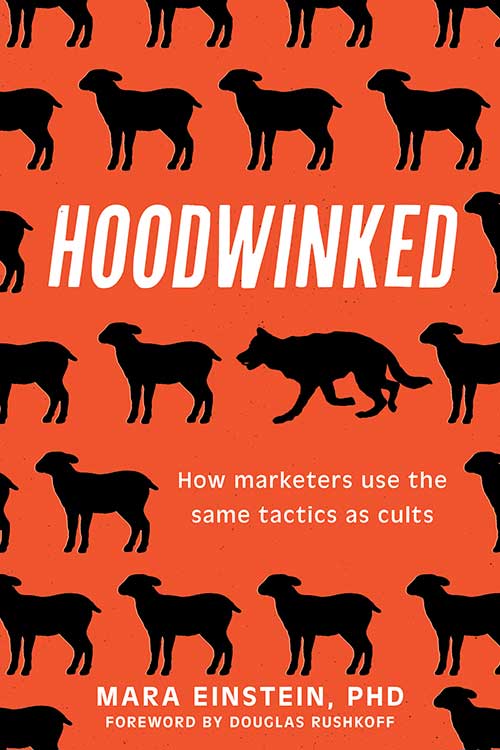
Acclaimed media scholar Mara Einstein believes that the marketing methods employed by retailers, airlines, higher-ed, and other organizations are akin to cult recruitment techniques. Her new book, Hoodwinked: How Marketers Use the Same Tactics as Cults, dives into how promotional strategies and social media may be deceiving and addicting us all.
 Checkbook: Why do you think marketers are like cult leaders?
Mara Einstein: Cults make a concerted effort to find large groups of people to bring into their belief systems. And like advertising agencies and marketers, cults are looking for vulnerable individuals. Both groups want to push against that vulnerability and suggest there is something wrong with you, and therefore you need their product or group to fix that.
For instance, at the beginning of the year, you can’t turn on any kind of media or social channel and not catch Serena Williams hawking for Ro.co [a GLP weight-loss drug] or somebody else talking about an exercise program. I keep seeing the Apple Watch being sold as something to make you exercise all year. Marketers are essentially saying, “You are not OK the way you are, and we have the answer.”
CB: Don’t brands try to make you feel like you’re their friend?
M.E.: Yeah. It often starts with a brand or product trying to bring you in as a member or insider. “Sign up for our emails for 10 percent off.” Or it could be a college admissions office acting as if it’s befriending prospective students by emailing them silly poems, dumb jokes, or even kitten photos. Cults make a concerted effort to find large groups of people to bring into their belief systems.
CB: When do you know you’ve gone too far with a brand or marketing ploy?
M.E.: Even ordinary brands create a walled-garden effect and kind of fandom. People coalesce around certain labels and form communities. Think Jeep, Nutella, Harley-Davidson. If you’ve ever tried to disconnect yourself from Apple, you know what I mean!
Are these brand cults as controlling as David Koresh? Obviously not—you have the ability to leave. But be aware that you’ve been pulled into this group, and there are levers in place to keep you there.

CB: How does social media feed this cult-like devotion to certain brands?
M.E.: If you think about all this from a standard marketing context, more and more retail outlets are disappearing. And people used to make human connections at brick-and-mortar retailers—the makeup counter at a department store, the small boutique in their neighborhood.
Now consumers often make those kinds of connections via social media. Social media is a cult where everything is created to get you to stay as connected as possible. You put that endless scroll with influencers incentivized to keep you engaged. No wonder so many people are hooked!
CB: So if Instagram and X have us addicted, how do we combat that?
M.E.: I’m not going to say stop using all social media. I don’t think that’s really possible. But you can reduce it. You can use an app-blocker like Brick, which limits the time you spend on your phone. You can create zones where you don’t allow your phone—the bedroom, the dinner table. Or clock the time you are spending on your phone…you’ll be surprised.
And I think some people are unplugging a bit now. We’re seeing more people wanting to spend time face to face.
CB: You also talk about multisensory marketing and how brands use that.
M.E.: Some of this isn’t new, like advertising jingles. Other tactics are a bit harder to detect. Disney parks even have Smellitzers pumping out scents specific to certain rides! If a store or hotel gets you into a space, they want you to connect to a product. Your olfactory sense is the most powerful sense, so it’s not a surprise that it’s just another tool being employed.

CB: So if I’m being lured into buying things, are there techniques to resist?
M.E.: Understand that the technology is designed to work against you. Amazon worked for years to figure out the exact combo of designs and ideas, to get you to push the button. And we all need to take a deep breath before we do that.
Traditionally, the way the marketing funnel works is you become aware of a product, you consider it, you purchase it, and you have the post-purchase reaction. That used to happen in a brick-and-mortar store, but that’s now happening in digital spaces and the funnel has collapsed. From awareness to purchase could happen in a second.
So if you want to spot being hoodwinked, put some air back into that space between awareness and purchase. Put your phone down—it’s a 24/7 mall! Don’t push the button immediately. Think about something before you buy it. Come back to it in an hour or a day.
CB: The book also dives into multi-level marketing. Why do people fall for it?
M.E.: It’s a multi-level marketing group if someone is trying to convince you that you can make a lot of money working from home, or that you have to purchase and sell things in order to make money. They’ll also want you to recruit others.
Multi-level marketing organizations are the one group of businesses which definitely parallel cult techniques. What happens is that people are vulnerable, it’s often stay-at-home mothers, and someone from their church says, “I have a way for you to make money at home.” And they see other people be successful.
Though there aren’t very many people who are successful, but there are enough who are that other people start buying products to try to meet their goals to grab the brass ring. And a lot of these MLMs have you do personal development sessions. People who get pulled in get training, and it’s all about talking back to yourself and say, “I can’t do this.” They’re never told that the system is the problem, it’s always them.
