

Last updated October 15, 2026
Open enrollment for 2027 Medicare coverage runs from October 15 to December 7, 2026. During this window, you can switch Medicare Advantage plans, change Part D prescription drug plans, or drop Medicare Advantage for Original Medicare.
The stakes are higher this year. Many standalone Part D drug plans are raising premiums sharply—we found some will jump by 200 percent. Some Medicare Advantage plans have reduced their service areas or eliminated their plans entirely, which will leave many consumers with fewer choices. On the plus side, more than 20 million people with Part B will get a one-time $90 payment to help offset higher costs.
Here’s what to know.
Review Your Annual Notice of Change
Medicare Advantage and Part D plans had to send their members an Annual Notice of Change by September 30. If you haven’t received yours, contact your plan and ask for it.
For Medicare Advantage plans, the notice covers changes to the provider network, premium, out-of-pocket costs (deductible, copays, and annual out-of-pocket maximum), and extra benefits, such as dental, vision, and hearing.
For both plan types, these notices cover changes to prescription drug benefits: Which drugs are covered, tiers, prior authorization rules, and cost sharing.
If your plan is leaving Medicare altogether or will no longer serve your region, you should have received a separate non-renewal notice.
Fewer Medicare Advantage Options
Nationally, beneficiaries on average can choose from 35 Medicare Advantage plans in 2027, down from 39 in 2026, according to KFF. But the picture varies widely by region. A few areas, including all of Alaska, will have no Medicare Advantage plan options in 2027, though CMS says more than 99 percent of beneficiaries will have at least one choice.
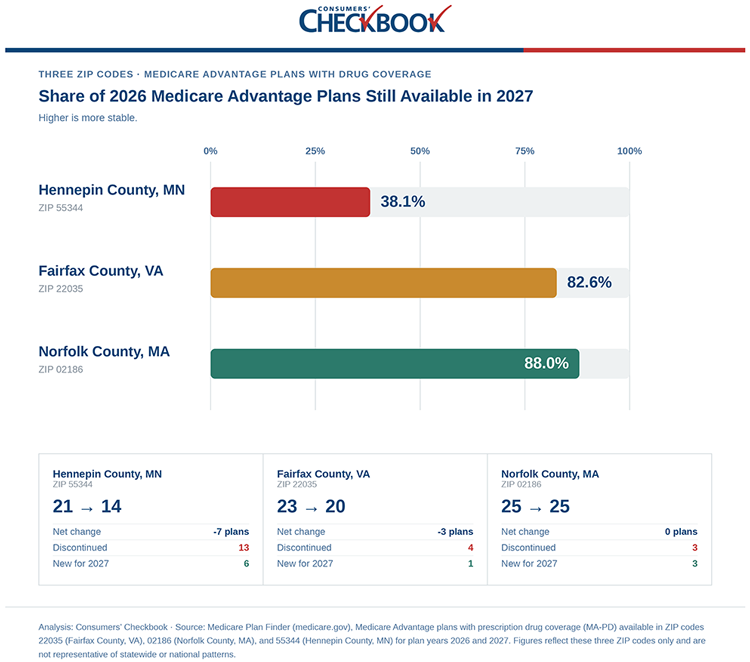
We looked at three areas to get a better understanding about Medicare Advantage plan availability: Fairfax County, Va.; Boston, Mass.; and Hennepin County, Minn.
We found that in some regions, consumers opting for Medicare Advantage plans will have similar choices as last year. In the Boston area, beneficiaries will have the same number of plans in 2027 as in 2026: three plans were discontinued and three new ones are starting.
In Fairfax County, four plans were discontinued, including all of Erickson’s, and one was added.
But Hennepin County will see a big drop in choices, 21 plans in 2026 to 14 in 2027.
Some people in discontinued plans are moved automatically to another plan from the same insurer, unless they sign on for a different option. But if your insurer is exiting from the Medicare Advantage program altogether, and you don’t choose a new plan, you’ll be moved to Original Medicare (Parts A and B) without drug coverage. That also puts you at risk of a Part D late-enrollment penalty later.
Another option if your Medicare Advantage plan terminates coverage in your area? Return to Traditional Medicare and enroll in a Medigap plan. Your situation counts as a “qualifying event,” which means you get guaranteed issue rights for a Medigap plan, and an insurer must sell you a policy regardless of your health history. That matters because once you’ve been enrolled in Medicare Advantage beyond your initial 12-month trial period, most states no longer give you the right to this “guaranteed issue,” and you’d have to go through medical underwriting to determine your Medigap policy prices.
Plan Availability for Part D
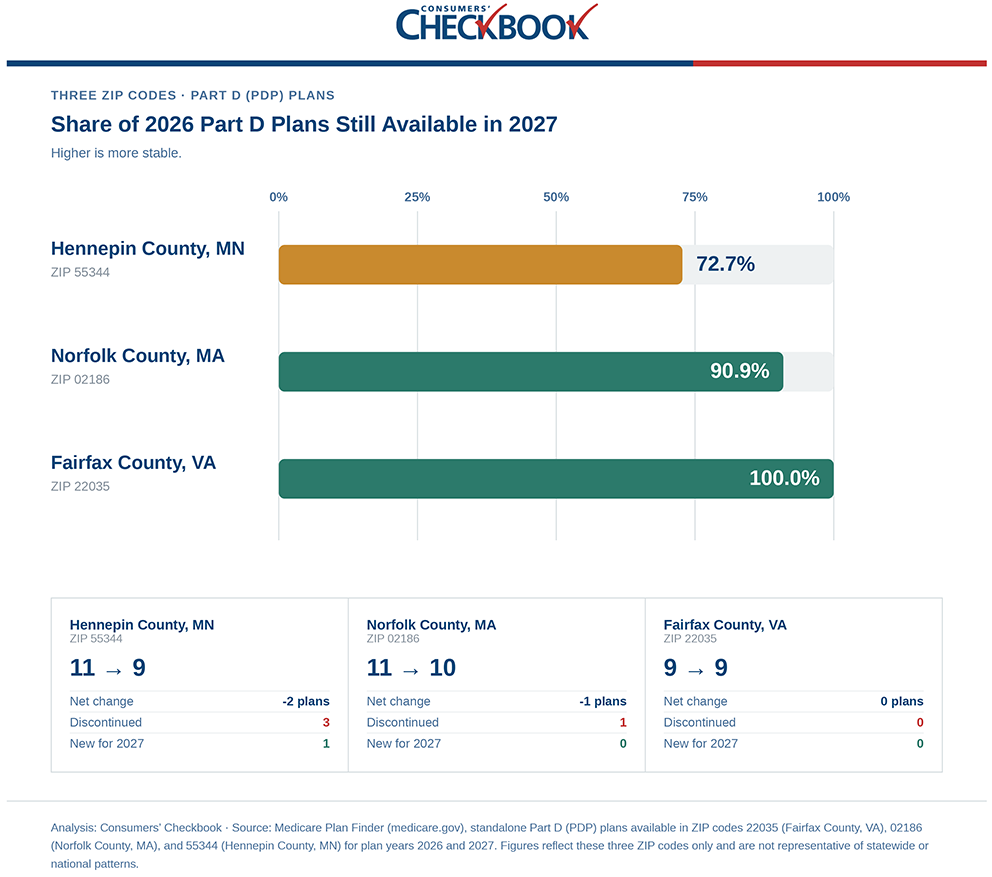
The number of standalone Part D plan options will also decline for many beneficiaries: Nationally, on average, they’ll have nine to choose from, down from 11, according to KFF. In the counties we checked, availability was steadier than for Medicare Advantage. Fairfax County has the same number of plans as last year, Boston has one fewer, and Hennepin County has two fewer.
If you lose your Part D plan, choose a new one during open enrollment to avoid late-enrollment penalties.
Costs Are Rising
Premiums. The Medicare trustees project the standard Part B premium will rise to $209.50 a month in 2027, up 3.25 percent from $202.90 in 2026. That’s an estimate; CMS usually announces the official premium in November.
Higher earners will pay even more. In 2026, the Income-Related Monthly Adjustment Amount (IRMAA) applies to people with income above $109,000 (single) or $218,000 (married filing jointly) and adds $81.20 to $487 a month to the Part B premium. CMS hasn’t yet announced the 2027 income thresholds and amounts. The Social Security Administration looks back two years, so your 2025 tax return determines whether you pay IRMAA in 2027.
Expect further increases. The trustees project the standard Part B premium will reach $360.60 a month by 2035.
Deductibles. Both are expected to rise. The Part A deductible, which covers inpatient hospital and skilled nursing care, is projected to rise to $1,788 for 2027, up from $1,736 in 2026. Remember that this isn’t an annual deductible; you may owe it more than once in a year if you have multiple hospital stays. The annual deductible for Part B, covering doctor services and outpatient care, is expected to increase to rise to $292, up from $283.
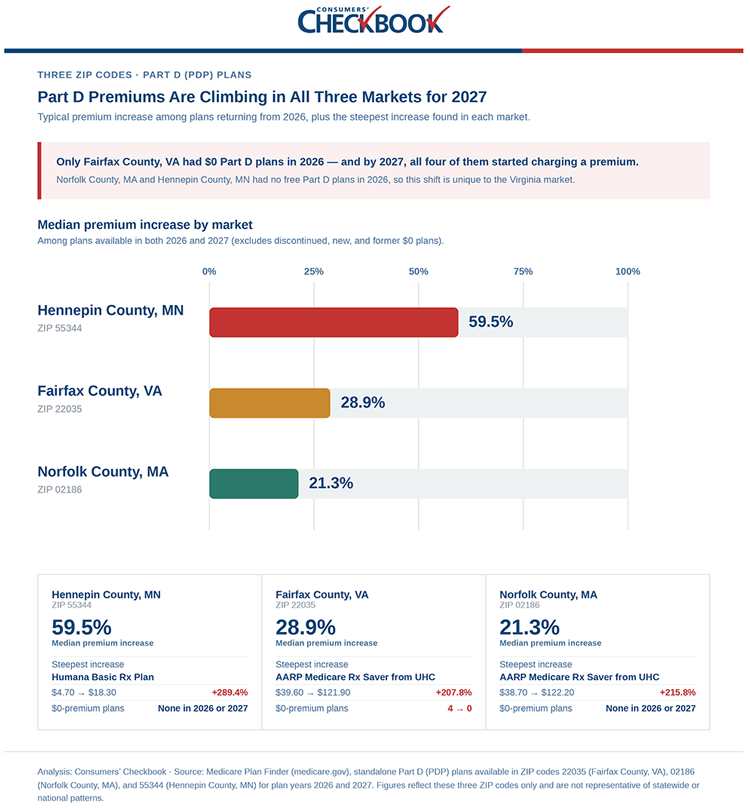
Standalone Part D premiums. CMS projects the average standalone premium will rise only from $35.09 to $36 a month. However, there can still be outliers which could greatly increase your costs next year. In Fairfax County VA, for example, we found AARP Medicare Rx Saver from UHC is increasing the plan premium by around 207 percent, from $39.60 to $121.90.
One other trend for next year is that there are no longer any $0 premium Part D plans. Not all areas of the U.S. had them this year, but in areas that did they are no longer available. For example, Fairfax County VA had four this year, and none in 2027.
Part of the jump follows the end of a temporary federal program, the Part D Premium Stabilization Demonstration. It paid extra money to drug plan insurers in 2025 and 2026 to hold down premiums, and CMS ended it after 2026.
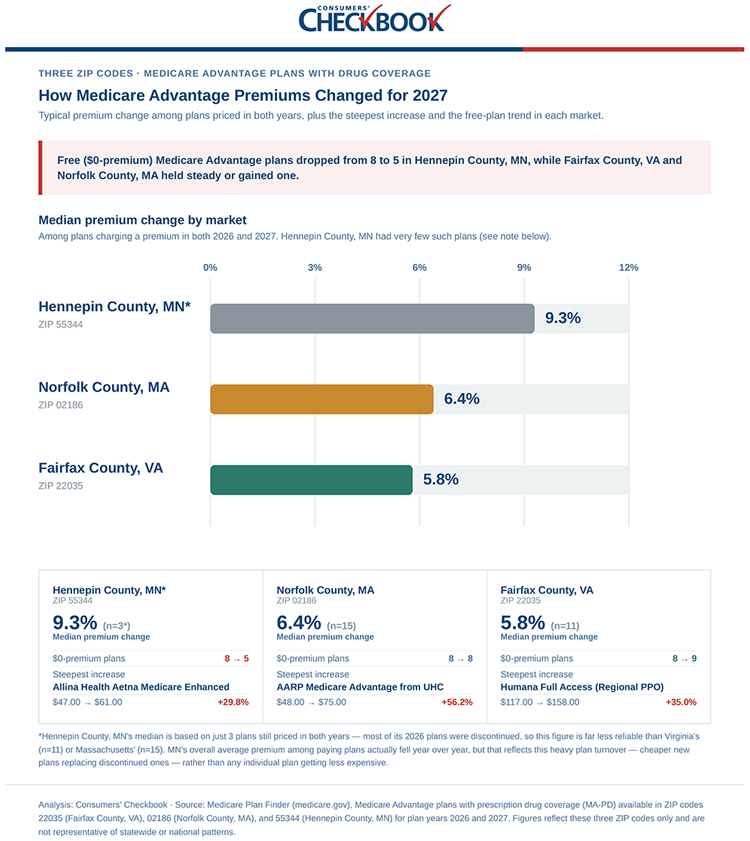
Medicare Advantage premiums. Many beneficiaries can still find a plan with no premium, and CMS projects the average Medicare Advantage premium will fall from $14.37 to $12 a month. Outliers exist, though. In Boston, for example, we found the premium for the AARP Medicare Advantage from UHC PPO plan rising from $48 to $75, a 56 percent increase.
Part D Out-of-Pocket Cap & Deductible
Whether you have a standalone Part D plan or Part D is integrated in your Medicare Advantage plan, the annual cap on your out-of-pocket drug costs rises 14 percent in 2027, from $2,100 to $2,400. The standard Part D deductible also will jump, from $615 to $700, though plans can charge less. The cap applies only to covered drugs. Check that all your medications remain on your plan’s list so the cap can protect you from large out-of-pocket costs.
GLP-1 Bridge Program
About one in eight adults say they are taking a GLP-1 drug for weight loss or another health condition, according to a KFF poll. Medicare has not covered these drugs solely for weight loss, though some Part D plans cover them for conditions such as Type 2 diabetes.
The temporary Medicare GLP-1 Bridge, which began July 1, 2026, changes that. For $50 a month, it covers Foundayo tablets, Wegovy (injection or tablet), and the KwikPen version of Zepbound. It doesn’t cover single-dose Zepbound pens or vials. The program ends December 31, 2027, and Medicare hasn’t said what comes next.
To qualify, you must be enrolled in Part D (a standalone plan), Medicare Advantage with drug coverage, a Special Needs Plan, or an employer or union group plan, and have a prescription for weight loss. You must also meet one of these:
- A body mass index (BMI) of 35 or higher.
- A BMI of 30 or higher plus heart failure with preserved ejection fraction, uncontrolled high blood pressure, or chronic kidney disease at stage 3a or higher.
- A BMI of 27 or higher plus prediabetes, a prior heart attack or stroke, or symptomatic peripheral artery disease.
You aren’t eligible if you have Type 2 diabetes, moderate-to-severe sleep apnea, or fatty liver disease (your Part D plan may cover a GLP-1 for those), or if your Part D plan already covers your GLP-1.
Your doctor must send a prescription, complete a prior authorization request, and certify that you’re in a diet and exercise program. The $50 payment doesn’t count toward your Part D deductible or out-of-pocket cap.
One-Time $90 Payment
The White House says more than 20 million people with Part B will receive a one-time $90 payment, funded by the Medicare Improvement Fund (fact sheet). You aren’t eligible if Medicaid pays your Part B premium, you’re enrolled in a Medicare Advantage plan, or you pay IRMAA.
Most eligible people will get a direct deposit in early October. Others will get a check. To check your eligibility, call 1-800-MEDICARE. To check your payment status, call the Social Security Administration at 1-800-772-1213. The payment covers less than half of one month’s Part B premium and doesn’t lower your premium.
Where to Get Help
You can go to Medicare.gov to compare your options for Medicare Advantage, Medigap, and Part D plans. For Medicare Advantage and Part D plans you can enter your prescription drugs and preferred pharmacy. You can then sort plans in order of lowest cost, the combination of plan premium, and out-of-pocket costs for your prescription drugs.
The State Health Insurance Assistance Program (SHIP) offers free, unbiased help from trained volunteer counselors.
Be cautious about brokers. Many know the program well, but they get higher commissions from some insurers than others, which might incentivize them to steer you toward options that are best for them, not you, or even to push you toward Medicare Advantage over Medigap. And they may not show you every plan option.