

Last updated June 2026
“All natural,” “Reduced sodium,” “non-GMO,” “USDA organic,” “healthy,” “whole food protein.” Food packaging often includes descriptors making it sound as if your breakfast cereal or veggie burger could improve your health—or that of the planet. But how trustworthy are these claims? And which ones should we take with a big grain of salt?
Some of these terms are meaningful but many are nonsense. Some are regulated by the government; others aren’t. It’s all confusing. To help you navigate the jumble of claims, here’s a guide to which food labels might help you improve your diet and which labels are so bogus you should ignore them.

Use Labels to Avoid Ultra-Processed Foods
Why do it?
Energy bars, frozen pizzas, sodas, hot dogs, and other ultra-processed foods make up about 53 percent of the calories in U.S. adults’ diets and a staggering 62 percent for children and teens, according to the Centers for Disease Control and Prevention (CDC). This literally may be killing us: High consumption of ultra-processed food is linked to obesity, cardiovascular disease, cancer, Crohn’s disease, kidney failure, depression, cognitive decline, dementia, and earlier death.
But how do you identify and avoid ultra-processed food? For now, you’ll have to scrutinize a product’s ingredient list (details below). There’s no government-sanctioned label to help you out yet; at the time of this writing, the Food and Drug Administration (FDA) was still working on its definition of ultra-processed food. And the CDC website offered only this page as a placeholder: “Ultra-processed foods tend to be hyperpalatable [translation: tasty, perhaps addictive], energy-dense [translation: high calorie], low in dietary fiber, and contain little or no whole foods, while having high amounts of salt, sweeteners, and unhealthy fats.”
Without a standard definition, be skeptical of descriptors that might imply that a food isn’t ultra-processed, such as “nothing artificial,” “clean,” “real food,” or “natural.” Because these claims aren’t regulated by the FDA, they’re often meaningless. But a soon-to-be rolled-out “Non-UPF” (ultra-processed food) seal may prove useful—it’s based on the Nova classification system, which puts food into four groups: (1) unprocessed/minimally processed; (2) processed culinary ingredients; (3) processed; and (4) ultra-processed.
Some researchers call for more nuance in the classification scheme since some processed foods, such as whole-grain bread, have nutritional benefits. The seal will be conferred, for a fee, by the same nonprofit organization that grants the “Non-GMO Project” certified seal.
What to look for on the package
The biggest tell that you might be eating an ultra-processed food? Ingredients not found in home kitchens—hydrogenated oils, food dyes, preservatives, and artificial sweeteners—often in a long list.
Depending on which state you live in, you may start seeing labels alerting you that a product contains certain food colorings, preservatives or other additives often found in ultra-processed foods. They’re likely drawn from a list currently under an FDA safety review as part of the “Make America Healthy Again (MAHA)” movement. For instance, a new Texas ruling calls for a warning label on foods sold in the state containing any of 44 additives—although it only applies to labels produced on or after January 1, 2027. The law is being contested in a lawsuit brought by a group of food and beverage industry trade groups.
Use Labels to Cut Back on Saturated Fat, Sodium, and Added Sugar
Why do it?
In excess, saturated fat can hike up LDL (“bad” cholesterol). Too much sodium raises blood pressure. And diets high in added sugar are linked to obesity, heart disease, and cancer. That’s why the U.S. government, the World Health Organization, and several other health authorities warn about these three dietary components.
A note about “added sugar”: It includes white sugar, agave syrup, high fructose corn syrup, and other sweeteners in sodas, cookies, salad dressings, and many other foods. That’s in contrast to naturally occurring sugar in fruit, milk, and vegetables. Which means sugar-sweetened yogurt contains both added and naturally occurring sugars (lactose from milk).
What to look for on the package
Nutrient content claims: For fat, sodium, and sugar, the FDA does regulate terms food companies can use, which means terms like “free,” “low,” “very low,” “reduced,” “less,” and “light” actually have some teeth. For instance:
- “Reduced,” “less,” or “fewer,” as in “reduced sodium” or “fewer calories,” means 25 percent less than the regular version of the food.
- “Free,” “zero,” “trivial,” or “negligible” means less than five per serving when it refers to calories; less than 0.5 grams per serving for sugar or saturated/trans fat; and under five milligrams per serving for sodium.
“FDA nutrient content claims can be used for good, to help nudge us towards healthier choices,” said Kelseanna Hollis-Hansen, a professor at the Friedman School of Nutrition Science and Policy, Tufts University, Boston.
Front-of-Package (FOP) labeling: You’ve probably noticed various versions of these charts but an upcoming FDA ruling will standardize the info, limiting it to saturated fat, sodium, and added sugars, although calories may also be listed. An example of a proposed layout is on the next page. (In the case of these three nutrients, the daily value means the maximum daily amounts.)

Sure, you’ll also find these same numbers on the nutrition facts panel on the back of the package. “But front-of-package labeling may help people quickly compare packaged products on the grocery shelf, enabling them to choose foods with lower saturated fat, sodium, and added sugars,” said William Hallman, a professor in the Department of Human Ecology at Rutgers University. He’s a psychologist who studies consumer perceptions of the risks and benefits of foods, food safety, food and agricultural technology, and food labeling.
He added, “If a substantial portion of consumers make these choices, it would incentivize manufacturers to reduce the levels of these ‘nutrients of concern’ in their products. If that happens, all consumers will benefit, regardless of whether they notice the FOP label.”
“Healthy”: Foods bearing this claim must contain a certain amount of at least one of these food groups: fruit, vegetables, grains, protein, low-fat or fat-free dairy, or olive oil. And foods labeled with “healthy” cannot exceed specific limits for saturated fat, sodium, and added sugars. However, other additives, such as artificial sugars, are allowed.
This FDA ruling on “healthy” labeling went into effect in April of 2025; companies have until 2028 to comply. Foods can for now still carry the claim, even though the FDA is still in the process of designing a standardized “healthy” logo.
While fresh fruits and vegetables, lean meat, seafood, and other whole foods are no-brainers for the seal, things get complicated with frozen meals or other offerings with multiple ingredients.
While your favorite frozen pizza might not make the cut (too high in sodium and saturated fat), here’s something that would: A salmon, green bean, and brown rice frozen entrée weighing at least 10 ounces, with no more than 20 percent of the Daily Value of sodium, a max of 15 percent for saturated fat, and no added sugars. A smaller entrée would have lower cut-offs for these nutrients.
“This claim can help people choose healthier options. We have strong evidence that certain foods and eating patterns can promote health and reduce the risk of diet-sensitive conditions such as heart disease and diabetes,” Hollis-Hansen said.
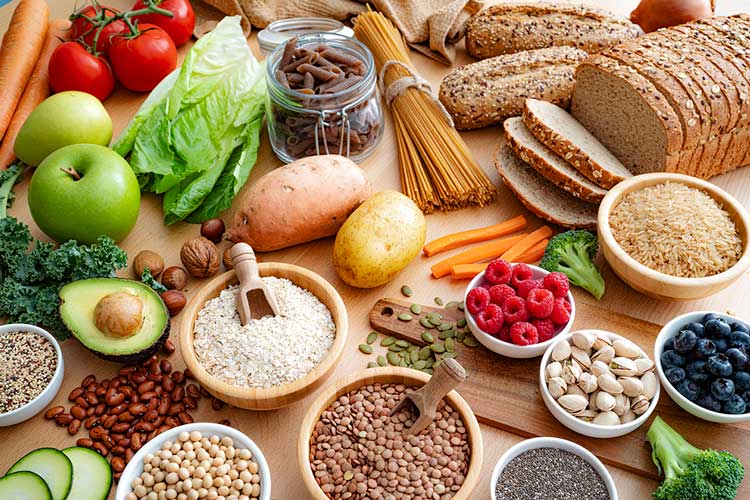
Take nuts and seeds, which qualify for the healthy label. “Many are rich in calcium, vitamin E or selenium, which are important for immunity; their healthy fats can help lower LDL and raise HDL cholesterol,” she said. Plain yogurt—linked to bone health and prevention of obesity, type 2 diabetes, and cardiovascular disease—would also make the cut, if low-fat or fat-free.
Use Claims to Get More Fiber, Calcium and Other “Good” Nutrients
Why do it?
Americans tend to run short on calcium (important for bone and cardiovascular function), potassium (helps lower blood pressure), dietary fiber (feeds the “good bacteria” in our gut and helps reduce blood sugar and cholesterol), and vitamin D (critical for bones and immunity). Some of us don’t get enough iron, which is needed to circulate oxygen around the body and is critical for fetal and childhood growth and development.
What to look for on the package
“High,” “good source,” and other FDA-regulated terms for vitamins, minerals, protein, and dietary fiber flag foods richer in these good-for-you nutrients. While the criteria are a little more complex, here’s the gist:
- “High,” “rich in,” or “excellent source of”: 20 percent or more of the Daily Value, which in the case of beneficial nutrients, is a rough indication of your daily needs.
- “Good source,” “contains,” or “provides”: 10 to 19 percent of the Daily Value.
- “More,” “fortified,” “enriched,” “added,” “extra,” and “plus”: Contains at least 10 percent more of the Daily Value than the regular version of a food.
Use Claims to Prevent a Disease
Why do it?
If you’re using the claims mentioned so far to cut back on the bad stuff and take in more of the good, then you’re already doing your body some favors! But to help you zero in on specific diseases, the FDA allows food manufacturers to link their products to reduced risk.
What to look for on the package
Twelve different “authorized health claims” are permitted. Essentially, the FDA issues approval if it has found that the food—or a nutrient in the food—is linked to reduced risk of a disease or condition.
Here’s an example of permitted language for calcium that you might see on a carton of milk or yogurt (both are rich in calcium): “Adequate calcium throughout life, as part of a well-balanced diet, may reduce the risk of osteoporosis.”
To complicate things, there are around 30 “qualified health claims” that don’t meet the scientific rigor of the authorized claims but have some research backing. For example, a bread manufacturer might note: “Scientific evidence suggests, but does not prove, that whole grains (three servings or 48 grams per day), as part of a low saturated fat, low cholesterol diet, may reduce the risk of diabetes mellitus type 2.”
Because there’s little scientific support for this claim, in this example the supposed evidence is being used as a marketing tool.

Use Claims to Cut Back on Pesticides
Why do it?
Pesticides, herbicides, and other chemicals that kill insects, weeds, and plant diseases can pollute the environment and may set us up for increased risk of diabetes, neurological, respiratory and reproductive disorders, cancer, and inflammation. For example, research suggests that the widely used weed-killer glyphosate could trigger inflammation, reproductive and neurological disorders, and disrupt the balance of our gut microbiome—the microorganisms in our digestive tract we need to stay healthy.
What to look for on the package
“USDA Organic”: To carry this seal, farms must go through a pricey certification process to ensure their crops and livestock meet the government’s specific organic-labeling standards. (At this time, seafood isn’t eligible for the seal, although the USDA has been mulling over regulations for wild-caught and farmed fish.)
To get the USDA Organic seal, among many other requirements, crops are grown with natural fertilizers and a restricted list of pesticides. That translates to fewer pesticide residues than conventionally grown foods, but not necessarily zero.
Organic farmers can use “natural” pesticides. “It should be noted that ‘natural’ does not always mean ‘harmless,’ especially if misused,” Hallman warned. For example, substances extracted from chrysanthemum flowers, called pyrethrins, might sound like a benign insecticide, but “these are toxic to fish and other aquatic animals and can cause skin and respiratory problems in those applying them,” said Hallman.
Keep in mind that food ecolabels like “cage-free,” “grass-fed,” and “pasture-raised” don’t mean the product is organic. These other terms may be conferred by third-party certification programs but sometimes are just meaningless marketing terms.
Organic produce often is more expensive than nonorganic. If you can’t afford to pay the higher prices, “go ahead and eat conventionally grown, as the benefits outweigh the risks,” Hollis-Hansen said. She points out that root vegetables, like carrots and onions, and produce with skins we discard, such as bananas and pineapples, tend to have lower pesticide residues. “On the other hand, produce with thinner skins and higher pesticide use, such as leafy greens, grapes, strawberries, and apples, are better bought organic when possible, to limit exposure,” she said. She recommends getting further guidance from Environmental Working Group’s “The Dirty Dozen” and “The Clean Fifteen.”
No matter what you buy, a good washing (even better, washing and soaking) can remove many pesticides and, depending on the food and the chemical, the difference can be substantial. Blanching—immersing in boiling water for one to two minutes—is also a good technique.

Don’t Get Blinded by the ‘Health Halo’
Not all claims help you choose nutritious fare—far from it. “Some claims give foods a health halo, so that consumers mistakenly perceive a product to be healthier than it is,” said Hallman.
Here are three (out of many) claims to view with a skeptical eye:
“Gluten-free”
Avoiding gluten—a protein in wheat, rye and certain other grains—is critical for people with celiac disease and can help those with non-celiac gluten sensitivity. But for the rest of us, the benefits are minimal, or even harmful, especially if we’re eating the chips, cookies, breads and many other not-so-nutritious foods bearing the gluten-free label. And, as the Harvard School of Public Health notes, “For those who are not gluten-intolerant, there is no data to show a specific benefit in following a gluten-free diet.”
Anything and everything “protein”
Americans average about 16 percent of total calories from protein, well within the 10 to 35 percent recommendation. Yet we’re in the midst of a get-more-protein craze—just search “carnivore diet” on TikTok or other social sites and you’ll get bombarded by calls to switch to a high-protein diet. Manufacturers are taking notice with protein-pumped breads, cereals, energy bars, drinks, and other foods, many of them junky. Exhibit A: High-protein breads and tortillas that are ultra-processed concoctions of protein isolate, modified wheat starch, gums, and other non-foods. A related health halo: “keto” foods which are high in protein and/or fat, essentially devoid of carbohydrates and may not have much to offer nutrition-wise.
Non-GMO (genetically modified organism)
Insert a gene or genes from one organism (plant, animal or microorganism) into another and you get a genetically modified food. Much of the corn grown in the U.S. contains an insect-resisting gene from a bacterium that grows in the soil. While just 14 ingredients in our food supply are GMO, some of them, like corn and soybean—are in many packaged foods.
While they’ve been dubbed “Frankenfoods”, Hallman said that’s fear-mongering. “Many national academies of science worldwide have reviewed the scientific evidence associated with consuming genetically engineered (GMO) foods and have concluded that those currently on the market are as safe to eat as conventional products,” he said.
Using the “Non-GMO verified” seal is completely voluntary; manufacturers pay a non-profit for the right to use it. You may have noticed that “Non-GMO” butterfly logo, but you may have missed the less-obvious “bioengineered” wording on packages, which has been mandatory for genetically modified foods since June 2025. Hallman points out that while “USDA Organic” foods, by definition, can’t be genetically modified, foods labelled “Non-GMO” are not necessarily organic.
And a reality check from Hallman: “Those farmers growing conventional ‘non-GMO’ produce can use yield-enhancing synthetic fertilizers, pesticides, and herbicides that organic producers cannot.”