

Hotels’ In-Room Smoking Sensors Falsely Charge Some Guests Hundreds in Fees
Last updated June 1, 2026
Many hotels are now using in-room sensors to detect smoking or vaping in non-smoking rooms. When triggered, guests are charged cleaning fees of $250 to more than $560. But Consumers’ Checkbook has heard from several travelers who never smoke or vape but were nonetheless hit with these fees. And they said hotel managers dismissed their denials.
Listen to audio highlights of the story below:
Last summer, Darus and Amanda Turner celebrated their wedding anniversary at the Venetian Resort in Las Vegas. They had a wonderful time until they saw their bill at checkout. The Turners, who never smoke or vape, were stunned to find a $566.90 “smoking fee” on their statement.
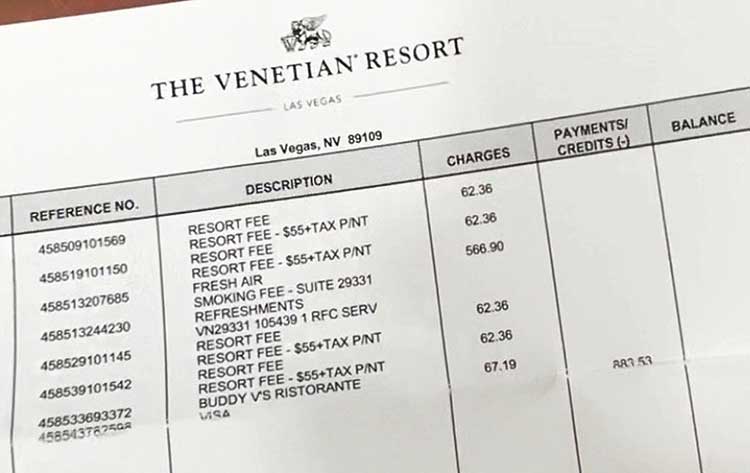
Worse still, the hotel’s manager refused to remove the charge. The couple said the manager would tell them only that the alarm was triggered at 11:52 p.m. That was around the time the couple had returned to their room, after first walking through the hotel’s casino, which was filled with “clouds of smoke.”
“It just wasn’t right,” Mr. Turner told Checkbook. “We just knew that we were being falsely accused of this.”
Faced with the impossible task of proving a negative, the Turners submitted their urine for lab analysis when they arrived home in Louisiana. The tests, which can detect nicotine for more than four days after usage, came back negative for nicotine and drugs.
The Turners made several unsuccessful attempts to challenge the fee with hotel management but were told the sensors “were 100% accurate.” So, the couple filed a fraud report with their bank and provided the test results as proof.
Even though they prepaid for their stay using a debit card, the bank refunded the $566 smoking fee.
Mr. Turner said he recognizes that hotel operators need to protect themselves from rule breakers. But, he said, “better procedures need to be put in place” to protect guests from false sensor readings.
“Are they really using this to catch people smoking, or are they using this for revenue?” he asked.
The same thing happened to Lauren Quirk when her family stayed at the Venetian Resort earlier this year. At checkout, she was charged a $566.90 “smoking fee,” and told the manager that no one in her family smoked or vaped.
“I was just met with the attitude that everyone lies, and that they have to do this because everyone’s going to go to the desk and say they didn’t smoke,” Quirk told Checkbook. “And I guess I’m a testament to the fact that everyone does not lie because I didn’t smoke.”
Quirk, who works in the travel industry, told the manager she found the experience “disheartening.” Getting hit with a surprise charge at checkout, she said, had “tainted her vacation experience.” The manager explained that “from a business standpoint,” the hotel had to do this. “To me, that was not a great business decision,” Quirk told Checkbook.
Faced with the prospect of disputing the charge with her credit card company, Quirk, who owns a travel company in Calabasas, Calif., spoke with someone she knew at the hotel and had the charge removed.
“My biggest problem with this entire situation was that it was my word against a machine or an algorithm, and in the eyes of the management at the time, it appeared that they were siding with the machine,” Quirk said.
The Venetian did not respond to Checkbook’s requests for comments about what happened to the Quirks or Turners.
Are Hotels’ Smoking Sensors Accurate?
Companies that sell these systems promote their accuracy and efficiency.
Rest, one of the big players in this growing market, notes on its website: “Hotel staff no longer need to rely on subjective methods, such as smell or guest complaints; instead, they can harness real-time, scientifically grounded data to make informed decisions.” Rest claims that its “field-tested algorithm” can identify the presence of tobacco, marijuana, or nicotine-based substances “with precision.”
Wynd Technologies similarly boasts that its sensors can identify cigarette, vape, and marijuana smoke “with >99% accuracy.” The company claims its Sentry System “ensures increased guest satisfaction and drives additional revenue for every hotel stay,” generating $2,500 to $5,000 additional revenue per room per year.
Christopher Elliott, a consumer advocate and syndicated travel expert, believes false positives occur more often than the industry admits. He’s received complaints from travelers across the country who insist they were improperly accused of smoking in their room.
Elliott also said he’s been told by “hotel insiders” that steam from an iron or smoke from a hair dryer could trigger the alarm.
“[These sensors] can pick up anything,” Elliott said on a recent episode of Checkbook’s Consumerpedia podcast. “Unfortunately, they have been picking up anything and mistaking it for cigarette smoke.”
Click below to listen to the full Consumerpedia podcast episode on travel gotcha fees.
If air-monitoring sensors are truly being used to deter smoking and vaping in non-smoking rooms, warning notices should be posted in those rooms to inform guests about the sensors and how they work, Elliott said.
“Anything else is completely deceptive,” he said.
A disclosure at check-in or during the booking process is not enough. Elliott believes the hotel should post signs in the room that read, “We use smoke detectors, and here’s how they work.”
A Growing Problem for Travelers
Checkbook couldn’t find data on how many hotels use air-quality monitoring sensors to detect smoking or vaping, but industry analysts told us the number is rising.
We found complaints on social media, in hotel reviews, and in news reports about disputed smoking fees tied to in-room sensors at hotels across the country, including Marriott, Sheraton, Hilton, and Hyatt properties.
Zach Griff, a travel reporter for The Points Guy, posted his frustration on Instagram after being charged a $500 smoking fee at the Pell Hotel (a Hyatt property) near Newport, R.I., last year. Griff believes the alarm was set off by a hair dryer, since neither he, his wife, nor their eight-month-old daughter smoked in the room. “A hotel scam I’ve never seen before,” he wrote on the post, “and even crazier, I’m not the only one this happened to.”
Several people have complained to the Better Business Bureau about being charged a $500 smoking fee at the M Social Hotel in New York City’s Times Square.
One guest, Rhaiany Leicy, said the hotel manager provided a document showing that the smoking took place when no one was in the room.
“I offered proof with time-stamped photos showing we were outside the property and asked them to verify via key card or security cameras, which they refused,” she said.
Management later provided her with a second report that indicated the sensor was activated at a different time.
“Regardless of the time,” Leicy said in her complaint, “the claim is false; no one smoked, and no verification was ever done.” Leicy shared her frustration on TikTok.
In response to similar complaints, the hotel told the BBB that its in-room air-monitoring devices “accurately report” when particles from smoking or vaping are detected, and they can “accurately differentiate among steam, shower, aerosols, hair spray, and cooking, etc.”
Protect Yourself
In most cases, the hotel won’t tell you if the smoke detection system has been triggered. And no one will come to the room to verify the violation. Remember, these systems are designed to avoid confrontation with guests. Instead, the smoking fee will be added to the bill, and you might not notice the extra charge at checkout. So, review your final bill and report any problems promptly.
Checkbook recommends using a credit card for all travel purchases because doing so provides you with the right to dispute charges if problems occur.
If you’re assessed a smoking fee and you know it’s an error, talk to the manager. If they won’t remove the charge, ask for written documentation. (A picture of a pack of cigarettes or a vaping pen on the dresser is not proof you smoked in the room.) If the hotel won’t remove the fee, dispute the charge with your credit card company. There’s a good chance you’ll win and get a refund.
And consider filing a complaint with the Better Business Bureau or with Elliott Advocacy, Christopher Elliott’s nonprofit organization that helps people resolve consumer issues.

Contributing editor Herb Weisbaum (“The ConsumerMan”) is an Emmy award-winning broadcaster and one of America's top consumer experts. He has been protecting consumers for more than 40 years, having covered the consumer beat for CBS News, The Today Show, and NBCNews.com. You can also find him on Facebook, Blue Sky, X, Instagram, and at ConsumerMan.com.