

How to Find a Reliable Roofer
Last updated November 2026
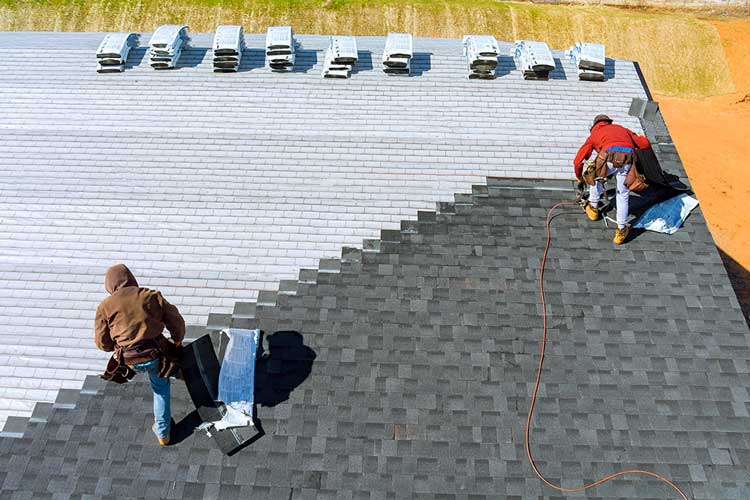
To get new shingles without a shakedown, identify several reliable contractors and collect bids from each, get in writing exactly what will be done, and then keep a close eye on the job as it progresses.
Our Ratings Tables report on Boston area roofing contractors. The Ratings Tables show which areas they serve and which types of roofs they work on. These ratings will help you identify high-quality companies.
Ratings from Homeowners
The ratings we report come from our surveys of consumers. We primarily surveyed Consumers’ Checkbook subscribers, but we also invited a sample of other area homeowners to participate. We asked survey respondents to rate companies they had used “inferior,” “adequate,” or “superior” for several questions, including: “doing work properly on the first try,” “promptness,” “letting you know cost early,” “neatness,” “advice on service options and costs,” and “overall quality.” For companies that received 10 or more ratings, our Ratings Tables report the percent of surveyed customers who rated each company “superior” (as opposed to “inferior” or “adequate”) on each question. The Ratings Tables also report the percent of each company’s surveyed customers who rated it “adequate” or “superior” (as opposed to “inferior”) for “overall quality.” Click here for more information on our customer survey and other data.
Many of the roofing outfits on our Ratings Tables were reviewed very favorably by a high percentage of their customers. Most of the companies were rated “adequate” or “superior” overall by 95 percent or more of their surveyed customers; several were actually rated “superior” overall by 90 percent or more of their surveyed customers. Unfortunately, however, substantial numbers of the customers of other outfits listed on our Ratings Tables regretted their choices: some of the companies were rated “inferior” overall by at least 20 percent of their surveyed customers.
Complaint Histories
Our Ratings Tables also report counts of complaints we gathered from the Better Business Bureau (BBB) for a recent three-year period and complaint rates relative to the volume of work companies do.

Payment Policies
To reduce the risk of dissatisfaction, pay for most or all of the work only after the job is completed. This gives you leverage to ensure that work is done properly and on time. Our Ratings Tables show what percentage of the contract price on a $15,000 roof installation job each company “ordinarily” allows the customer to pay upon completion or later. Many companies allow you to withhold the entire amount until completion. We strongly advise you to choose a contractor that requires no payment before work begins—or certainly not more than 10 percent of the contract price.
Warranty and Shingle Options
If you get a new roof, you should get two kinds of warranties: one on materials from the manufacturer, and another on workmanship from the roofer. Manufacturers also offer extended warranty protection.
Evaluating Shingle Quality and Manufacturers’ Warranties
Most shingle manufacturers offer similar warranties to one another that agree to cover the cost—including labor—to repair or replace shingles only if they are proven to be “defective”—a somewhat unlikely risk. Don’t assume lengthy warranty periods cover you against all leaks and other common problems, or even that you will be protected long-term from product defects. A manufacturer’s warranty generally begins with a specified time period (for example, five years) during which the warranty covers the entire cost of replacing defective shingles.
After the initial period, the manufacturer’s exposure is reduced on a pro rata basis each year for the remainder of the warranty’s duration.
When collecting proposals from roofing contractors, press each for advice on shingle options. For asphalt roofs, many homeowners now opt for “architectural shingles,” which are more attractive and usually more durable than standard “three-tab” options, but the upgrade likely will increase the total cost of your job by at least 20 to 30 percent; some high-end models will double or triple your costs. Will the more expensive shingle last 20 to 30 percent longer? It’s impossible to predict. Even if it does, most homeowners won’t stay in their homes long enough to benefit from the better product.
Roofers often use the length of manufacturers’ warranties to describe various shingle options (for example, “a 50-year architectural shingle” or a “30-year three-tab” product). The term “lifetime” also gets thrown about. But the duration of these warranties doesn’t necessarily correlate with shingle quality; for example, there’s little evidence that 50-year shingles are more durable than 40-year ones. Also, the term “lifetime” refers to the number of years the manufacturer reasonably expects its products to remain serviceable—not your lifetime or even how long you might own your home.
Because they’re more durable and fire resistant than standard shingles, metal roofing materials are also increasing in popularity. Warranties for these products are longer and have fewer limitations. But metal roofing is typically two to three times more expensive than standard asphalt shingles.
Also consult Consumer Reports’ roofing ratings. It recently tested asphalt shingles (15 models) and metal roofing materials (six models) and rated them for strength, wind resistance, impact resistance, and corrosion. As you might expect, the heaviest materials fared better than lighter options—but, again, performance came at a high cost: CR estimated that its highest scoring asphalt shingle costs three times more than the highest rated three-tab option.
Another consideration in your choice of shingles? Effect on your homeowners insurance premiums. Most companies now provide small discounts for homes with roofing materials that abate risk of claims from fire or wind damage. But those small savings likely won’t add up over the years to pay for the far higher costs of your roof upgrade.
Warranty from the Roofer
Roofers’ warranties on their labor often aren’t spelled out as clearly. Some simply say “labor guaranteed for X year(s).” Others say “guaranteed against defects in workmanship for X year(s).” Roofers’ warranties most often cover one to two years, but some are in effect for five years or more.
Because these statements can be unclear, ask for specifics. Will you recover costs or have work redone for free only if you can prove things were done improperly or just if the roof leaks? And if workmanship is defective, does the contractor have to provide materials in addition to labor?
To nail it all down, ask roofers to supply the following warranty: “If roof leaks within X year(s), except as a result of accidental damage, contractor will bear the cost of labor and materials to eliminate all leaks.”
Don’t Bother Paying for Extended Warranties
To supplement warranties—and to protect yourself if roofers go out of business and aren’t around to honor their warranties—most manufacturers now offer extended warranties on workmanship. To buy one, you must use a properly licensed, insured contractor approved by the writer of the warranty. Also, the warranty seller will require the roof to be installed according to proper specifications.
Extended warranties usually cost $5 to $20 per 100 square feet of the roof, depending on the length of the warranty. If your roof measures 2,500 square feet, and a typical 20-year extended warranty costs $10 per 100 square feet, you’d pay $250. As with most extended warranties, we here at Checkbook doubt that the value of these manufacturer-offered warranties justifies the cost, but they do represent additional protection.

Licenses and Bonds
Think ahead about obtaining additional leverage in case you’re dissatisfied with a contractor’s performance. A company may seem conscientious and cooperative early in the process, but prove harder to live with later.
By choosing a contractor registered with the Massachusetts Office of Consumer Affairs and Business Regulation, you ensure that the threat of registration cancellation can be used as leverage for resolving disputes. With a registered contractor, you also enhance the chances that the officials will feel you deserve their help. Ask any contractor you are seriously considering to present proof of a currently valid registration; then verify by calling the Office of Consumer Affairs and Business Regulation at 617-973-8787 or by checking its website at mass.gov/ocabr.
An additional advantage of hiring registered contractors: You may be able to collect up to $25,000 from the state’s Home Improvement Contractor Guaranty Fund if you are unable to collect a claim against the roofer—particularly desirable if the roofer goes out of business.
If you wish protection beyond government registration requirements, ask your contractor to secure a “performance bond” in the amount of your contract price. This will add an extra one percent to five percent to the price of the job, but the bond will cover your full claim.
Insurance Coverage
Make sure the contractor carries liability and workers’ compensation insurance. A liability policy pays for damages to your home (or your neighbor’s) if a ladder falls through a bay window; workers’ compensation pays for injuries sustained by the worker who tumbled. Without these policies, you could be liable. Before signing a contract, require the contractor to show you current certificates of insurance for both types of policies.
Financial Soundness
Make sure your roofer will be around to finish the job and that you won’t be left fending off the roofer’s creditors—who could put a lien on your house.
A good way to assess financial soundness is to obtain—and check—references. Ask for the names of major materials suppliers; then ask them how much credit they commonly extend and about the contractor’s recent payment performance.
Avoiding Storm-Related Scams
If your roof has been damaged during a storm, beware of contractors who suddenly appear offering help. Many roofers chase storms, traveling from area to area in search of easy money. Some of these companies perform good work, but many do not; and if your newly repaired roof begins to leak a year or two later, it could be hard to track down the out-of-area contractor.
A big red flag: Any company that promises to install a new roof at zero cost to you by covering your deductible. Filing a claim on that basis is insurance fraud, and your insurer could hold you responsible for it and demand you cover all costs—and then revoke your policy.
Also, for work covered by homeowners insurance, don’t sign an assignment of benefits, which some contractors ask for after storm damage. This document transfers your right to negotiate with your insurer directly to the contractor—meaning claims can be filed and settled in your name without your full knowledge or approval. This can leave you on the hook for a bill you never agreed to.