

FCC Weakens Price Transparency Rule for Broadband Providers
Last updated September 16, 2026
The Federal Communications Commission (FCC), which has become far more business-friendly under the Trump administration, has ordered changes to its broadband label rule. The original rule, approved during the Biden administration, made it more difficult for companies to obscure the full prices of their services.
Listen to audio highlights of the story below:
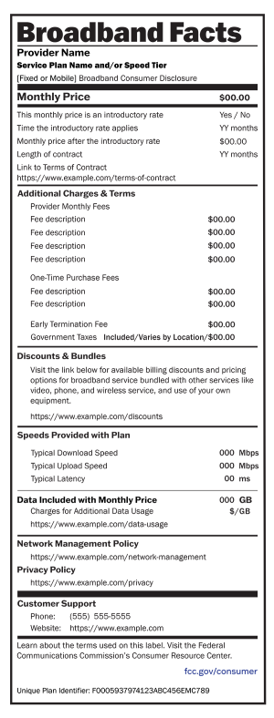
As Checkbook reported in April 2024, when the “Broadband Facts Labels” rule took effect, internet service providers (ISPs) were required to use standardized labels, similar to Nutrition Facts labels on packaged foods, that listed prices, introductory rates, data allowances, and speeds. Each broadband plan was required to have a separate label, displayed at all points of sale, including online and in stores.
 Jessica Rosenworcel, the FCC chairwoman at the time, said the labeling disclosures were designed “to make it simpler for consumers to know what they are getting, hold providers to their promises, and benefit from greater competition—which means better service and prices for everyone.”
Under the modified rule, which took effect this week, ISPs are no longer required to display the Broadband Facts labels along with the plans being offered; instead, they can provide a link to more information, and specific fees can be consolidated into an “up to” number that makes it impossible to know the cost of specific passthrough fees and which ones went up if the total price of your service increases.
In a news release explaining its action, the commission said the updated rule ensures consumers have the information they need to comparison shop for high-speed internet service while minimizing “some of the confusion and frustration” consumers have experienced with the current price disclosure format and reducing compliance costs for ISPs.
Ryan Johnston, a lawyer with The Utility Reform Network (TURN), a consumer advocacy group in California, called the original rule “a really good transparency tool” that was working as intended.
“It’s pretty straightforward. We all know how to read food product labels,” Johnston said.
On its website, TURN points out that ISPs routinely raise monthly bills above advertised rates by tacking on fees that the companies claim offset charges imposed by local governments. Displaying an “up to” price, TURN says, would “dilute the effectiveness of the label and increase consumer confusion around how the final price they pay is calculated.”
Also, under the modified rule, ISPs no longer need to make their Broadband Facts Labels machine-readable, so customers who use assistive technologies on their digital devices may be unable to easily access this information.
Teresa Murray, consumer watchdog director at the U.S. Public Interest Research Group (U.S. PIRG), called the commission’s actions “very troubling,” and said the weaker disclosure rules will add to customer confusion.
“These rules were created because there were so many internet providers that played fast and loose with price disclosures,” Murray told Checkbook. “Frankly, even when everything was being disclosed, it can be difficult to know what was being promised.”
The modified rule does not require ISPs to do anything; it simply allows changes that could make it harder for consumers to know what they’re buying.
Because the industry lobbied the FCC to modify its rule, you should expect to see less price transparency going forward.
“This is just not good for consumers,” Murray said.

Contributing editor Herb Weisbaum (“The ConsumerMan”) is an Emmy award-winning broadcaster and one of America's top consumer experts. He has been protecting consumers for more than 40 years, having covered the consumer beat for CBS News, The Today Show, and NBCNews.com. You can also find him on Facebook, Blue Sky, X, Instagram, and at ConsumerMan.com.