

Phone Companies Not Blocking Spam Robocalls as Required by Law, New Report Finds
Last updated November 12, 2026
In 2021, the Federal Communications Commission (FCC) launched a new effort to combat illegal robocalls. It required phone companies to implement caller authentication technology to verify that calls really come from the numbers shown on caller ID. The technology, known as “STIR/SHAKEN” was designed to protect consumers by making it easier to trace and block fraudulent calls. The compliance deadline was December 31, 2023.
Five years later, only 42 percent of phone companies (4,853 out of 11,467) have fully installed this technology, according to an analysis of FCC records by the consumer advocacy group U.S. PIRG. That percent of companies in compliance is now actually lower than it was in 2025 (45 percent). Compliance has never reached 50 percent, the report noted.
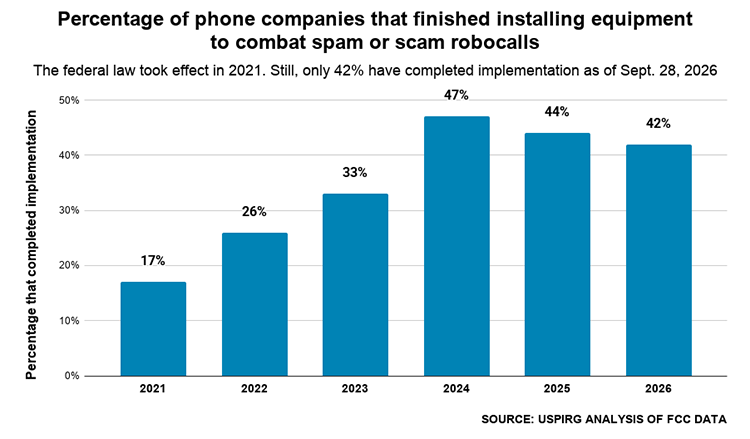
Many of the largest phone companies in the U.S. have failed to completely install required robocall-fighting technology.
“In some cases, it may be because they have a lot of old-fashioned copper wire lines, or they just haven’t gotten around to it. In other cases, they don’t seem to care,” said Teresa Murray, director of the Consumer Watchdog program at PIRG and author of the report. “It’s a big part of the problem when you have a major provider that doesn’t have this technology on their entire network.”
In announcing the crackdown in 2021, Jessica Rosenworcel, then acting chairwoman, said the technology would “turbo-charge” the agency’s anti-robocall tools. PIRG says the FCC’s enforcement of its STIR/SHAKEN rule has been “inconsistent.”
Last year, the commission prohibited 1,400 phone companies from connecting to U.S. phone networks. Another 14 were blocked in September. But Murray would like to see the FCC “swing a bigger stick” and shut down more bad actors who profit from allowing illegal robocalls on their networks.
This summer, New York Attorney General Letitia James and a bipartisan coalition of 49 other attorneys general sent a letter to the FCC urging it to strengthen its rules to fight illegal robocalls. When calls aren’t properly screened, spam robocalls and texts are more likely to get through, she said.
Many people still answer calls or respond to texts, even when labeled as spam. More than one in five (21 percent) of the adults surveyed by AARP earlier this year said they answer calls from numbers they don’t recognize at least half the time, and 10 percent reply to unknown texts at the same rate.
Robocalls and Texts Are More Than Just Annoyances
Some robocalls and robotexts are welcome, such as agreed-upon reminders about a doctor’s appointment or prescription refills, or alerts about a school closure. It’s the illegal robocalls and texts from scammers that must get shut down.
By manipulating caller ID—what’s called “spoofing”—criminals can trick us into responding by making it seem like the call is important: from a bank, credit card company, hospital, local police department, utility, or government agency, such as Social Security, the IRS, or Medicare.
Nationwide, the number of spam robotexts exceeds the volume of spam robocalls, but the calls tend to do more damage.
PIRG’s analysis of Federal Trade Commission data for the first half of 2026 found that victims who reported losing money to phone scammers lost an average of $3,973. When the scam started with a bogus text message, the average loss was $1,960. And most fraud victims never file a report.
“The best way to stop a robocall or text is to never let it start,” said Alex Quilici, CEO of YouMail, one of the largest robocall-blocking services in the U.S. “It’s a lot of work to try to block it at the termination side when it’s hitting a device or a phone.”
Criminals Are Using AI to Make Their Scams More Believable
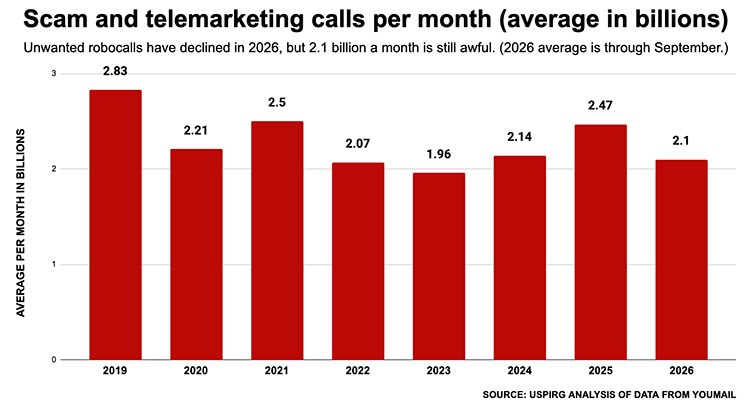
The volume of unwanted robocalls has dropped in recent years, from about 2.8 billion a month in 2019 to 2.1 billion a month now, according to YouMail. But ”There’s been tremendous adoption of AI in the fraud community,” Quilici told Checkbook. “You don’t need to call everybody on the planet to find a 65-year-old with Alzheimer’s; you simply get an Alzheimer’s list and call those 200,000 people.”
The bad guys use AI to grab data from different sources and use that information to convince you they are who they claim to be. AI also helps them decide who to call, how to craft their pitch, and discover which scenarios work best.
AI-generated voices sound real, and AI-generated texts don’t have the obvious signs of fraud, such as misspellings and typos.
The recent deluge of robotexts about unpaid parking tolls, which Checkbook has warned about, “did really well” for the scammers, Quilici said, because the messages were believable and required little effort.
Protect Yourself
It isn’t always easy to recognize fraudulent phone calls or text messages, and you can’t rely on your phone company or spam filters to block everything. Here’s what to do:
Don’t answer calls or texts from unknown numbers. If a call or text comes from a number not in your contact list, let it go to voicemail and deal with it later. Add businesses you deal with regularly, such as your doctor or dentist, to your contacts list.
Don’t trust caller ID. It’s easy for scammers to make caller ID display any name or number they want. It’s now part of the con job—a way to build trust and encourage you to engage.
Don’t engage. If you do take the call, don’t confirm or provide any personal information. Don’t press any keys to speak to someone.
Don’t panic. Fraudsters often use fear to pressure you into acting without thinking about the consequences. Don’t be fooled into thinking the caller is legit just because they have a lot of your personal information, even your Social Security or bank account number. This information has been exposed through numerous data breaches and is available to criminals on the dark web.
Take a deep breath, then contact someone you trust to decide how, or whether to respond. Call the AARP Fraud Watch Network Helpline at 877-908-3360 and talk to a trained fraud specialist about how to proceed. (You don’t need to be an AARP member to use this service.)
Don’t be afraid to hang up. “You do not owe a telemarketer or scammer an explanation, a polite sign-off, or a conversation,” AARP advises. Simply say you’re not interested, then hang up. Phone bandits are trained to keep you on the line because the longer they talk, the more likely you are to do what they want.
Check it out the right way. If you want to make sure there isn’t a problem with your credit card, bank account, or utility service, use a phone number you know is legitimate. Go to the company’s website or look at a bill. Don’t trust phone numbers or links provided by the caller or in the text message.
Take action. Check what free tools your phone company offers. You might also consider third-party services, such as Nomorobo, YouMail, and Truecaller. CTIA, the wireless industry’s trade association, provides information on mobile devices, including reputable robocall-filtering software for Android and Apple devices.
Consider creating a “safe word” for your family. This will come in handy if someone calls claiming to be calling about a loved one in trouble. If the caller can’t provide the safe word, they’re probably a scammer.
Murray recommends talking to family and friends about the ongoing threat from robocalls and robotexts. As attacks become more targeted, it’s important for everyone to stay alert.
Report illegal or unwanted robocalls and texts to your phone carrier and the Federal Communications Commission. If you’ve fallen for a scam, file a complaint with the FBI’s Internet Crime Complaint Center, the Federal Trade Commission, and Fraud.org, which will share this information with law enforcement partners across the country. The experts at the AARP Fraud Watch Network can advise you on steps to take to prevent further harm.

Contributing editor Herb Weisbaum (“The ConsumerMan”) is an Emmy award-winning broadcaster and one of America's top consumer experts. He has been protecting consumers for more than 40 years, having covered the consumer beat for CBS News, The Today Show, and NBCNews.com. You can also find him on Facebook, Blue Sky, X, Instagram, and at ConsumerMan.com.